Editorial note: This is an independent analysis by Ultra Hive Media based on public information available on 3 September 2026. Ultra Hive Media was not involved in the campaign. At the time of publication, the South African Civil Aviation Authority’s review of the Cape Town flyby was still in progress, and no final regulatory finding had been published.
Most sponsorships are announced with a press release, displayed on a backdrop and remembered only when a logo appears beside the event name. Airlink chose a more ambitious route for its involvement in Rugby’s Greatest Rivalry 2026: it made the airline’s actual aircraft part of the spectacle.
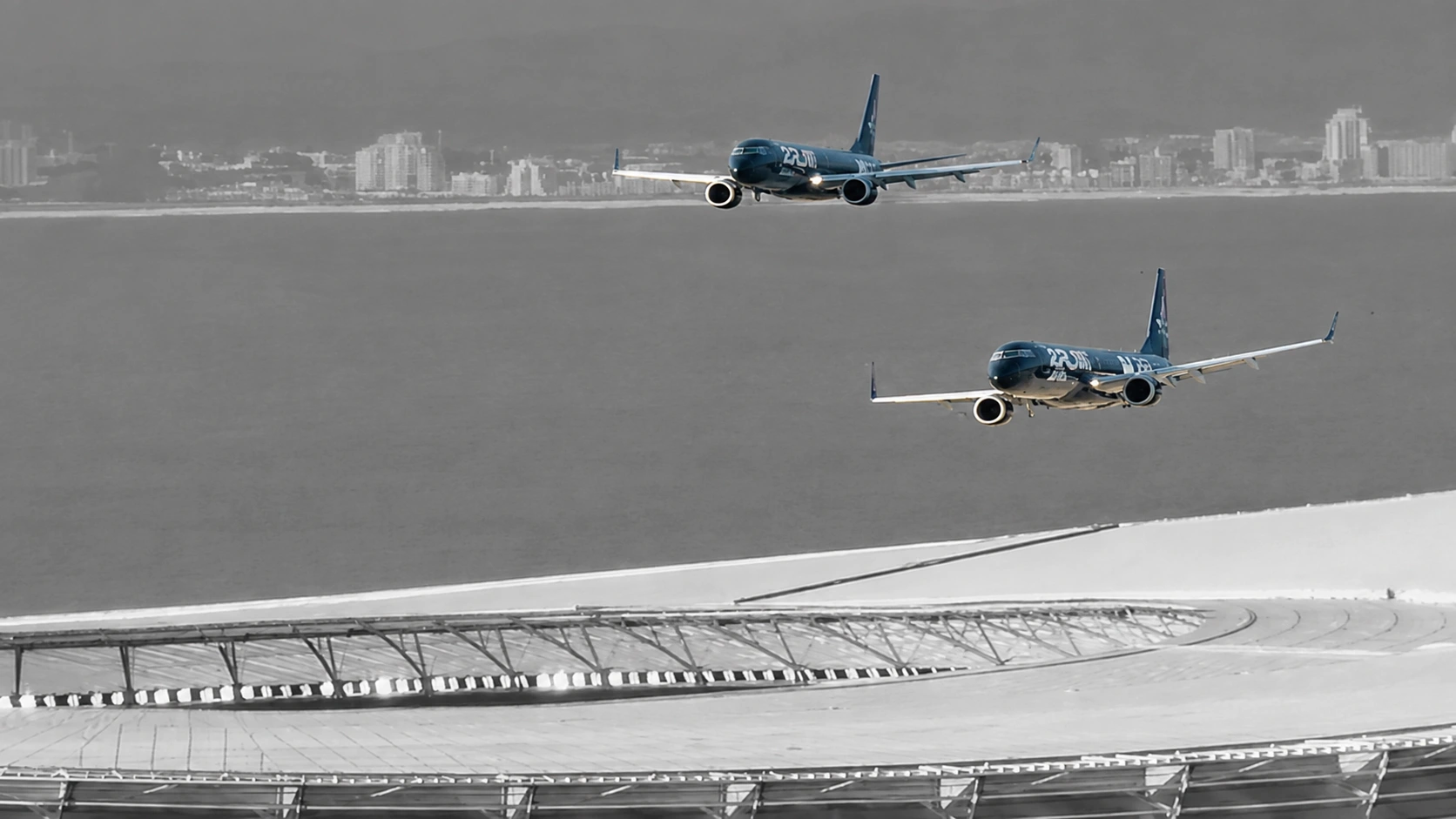
The result was one of Southern Africa’s most visible live brand moments of the year. A green Embraer representing South Africa and a black aircraft representing New Zealand flew in formation above Ellis Park and, one week later, over Cape Town’s DHL Stadium before the Springboks faced the All Blacks. The Cape Town flyby was captured from countless angles, replayed across social media and reported internationally.
It was also controversial. The apparent proximity of the aircraft to the stadium roof prompted questions from aviation experts and an official review by South Africa’s aviation regulator. Airlink maintained that the flight had been approved, carefully planned and executed within rehearsed limits.
This tension makes the campaign more valuable as a creative advertising case study. It demonstrates how product truth, cultural memory, sponsorship, live experience and earned media can combine to produce extraordinary attention. It also demonstrates why operational and reputational risk must be treated as part of the creative idea rather than as a separate concern.
Campaign Snapshot
| Case study element | Publicly documented detail |
|---|---|
| Brand | Airlink |
| Sponsorship property | Rugby’s Greatest Rivalry 2026 |
| Brand role | Official domestic airline for the tour |
| Functional contribution | Transporting South African and New Zealand teams and personnel between South African match cities |
| Distinctive assets | A green Embraer E190 and black Embraer E195 carrying tournament-related liveries |
| Hero activation | Formation flybys over Ellis Park on 22 August and DHL Stadium on 29 August 2026 |
| Wider activation | Aircraft branding, team transport, digital content, match-ticket competitions and Skybucks-linked engagement |
| Earned-media outcome | Extensive domestic and international reporting, social sharing and public debate |
| Important limitation | No verified campaign reach, brand-lift, booking or return-on-investment figures were publicly available at publication |
| Current risk status | SACAA was reviewing the Cape Town flight data; Airlink later withdrew its proposed FNB Stadium flyby, citing an unfavourable weather forecast |
Airlink’s official announcement positioned the airline as the tour’s domestic carrier, responsible for moving the teams and support personnel between fixtures in South Africa. This meant the sponsorship began with a credible operational role rather than a superficial association. The airline was not simply attaching its name to rugby; it was helping the tour move. Airlink’s partnership announcement provides the foundation for the activation.
The Creative Challenge: Make an Airline Sponsorship Feel Essential
The difficulty with many sports sponsorships is not visibility but meaning. A sponsor can receive logo placement, hospitality access and mentions throughout an event without giving the audience a clear reason to connect the brand with the occasion.
Airlink had a natural strategic advantage. Rugby’s Greatest Rivalry was structured as a travelling series, with provincial matches and Tests staged across several cities. Movement was central to the event, and an airline was essential to that movement.
The creative opportunity was therefore not to invent a loose connection between flying and rugby. It was to dramatise a relationship that already existed. Airlink could truthfully say that it was connecting the tour because its aircraft were transporting the people who made the competition possible.
| Sponsorship problem | Airlink’s strategic response |
|---|---|
| Sponsor visibility can feel passive | The aircraft became active participants in the occasion |
| Airline partnerships can look interchangeable | Team colours and bespoke liveries made the association distinctive |
| Operational support usually happens out of sight | The flybys transformed logistics into public theatre |
| Match-day attention belongs primarily to the teams | Airlink entered the emotional build-up without interrupting the game itself |
| A live event reaches a finite stadium audience | Spectacular footage encouraged broadcast replay, fan recording and earned-media circulation |
This is the campaign’s most important strategic lesson: the strongest activation was already inside the product. Airlink did not need to pretend to be part of rugby culture. It needed to make its real role visible and emotionally resonant.
The Big Idea: Turn the Product Into the Media
Aircraft usually carry advertising. In this activation, the aircraft were the advertising.
Airlink unveiled its green Embraer E190, registration ZS-YAE, at the end of June 2026. The airline explained that the aircraft formed part of its Skybucks loyalty-programme livery series and that the green reveal coincided with its appointment as Rugby’s Greatest Rivalry’s official domestic airline. The tournament logo appeared on the aircraft and was also planned for its black sister aircraft, ZS-YDE. Airlink’s livery announcement connected the physical asset, the loyalty programme and the rugby partnership before the first Test flyby took place.
Green and black performed several jobs at once. They distinguished the two aircraft, represented the colours associated with the Springboks and All Blacks, and made the rivalry understandable without a lengthy explanation. When the aircraft appeared together, the campaign’s central story was visible in a single frame: two rivals, one tour and one airline connecting both.
That simplicity mattered. People recording the moment did not need to repeat campaign copy for the content to make sense. The live image carried the idea.
| Creative layer | Role in the campaign |
|---|---|
| Product truth | Airlink was genuinely transporting teams and personnel during the tour |
| Distinctive colour | Green and black made the rival teams immediately recognisable |
| Branded physical asset | The aircraft became mobile media across ordinary routes and match cities |
| Live choreography | The formation flyby transformed sponsorship into an event |
| Broadcast visibility | The activation appeared within the emotional build-up to major Tests |
| Social participation | Spectators supplied multiple camera angles, reactions and commentary |
| Earned media | Debate carried the Airlink name far beyond the original audience |
This is a form of media efficiency that cannot be understood through placement costs alone. One execution generated a stadium experience, broadcast content, social footage, public relations material and ongoing commentary. The same asset performed across several channels because the idea was designed to travel.
From Partnership to Spectacle: How the Campaign Built Momentum
The flyover did not arrive as an isolated stunt. Publicly available material shows a sequence in which the partnership, liveries and live activation reinforced one another.
| Date | Campaign development | Strategic value |
|---|---|---|
| 24 June 2026 | Airlink announced as Rugby’s Greatest Rivalry’s official domestic airline | Established a credible role linked to transport and connection |
| 30 June 2026 | Green Skybucks Embraer E190 unveiled with the tour logo | Introduced a distinctive physical asset before the main Tests |
| August 2026 | Airlink promoted the tour, travel and ticket opportunities | Extended the sponsorship into audience participation and loyalty engagement |
| 22 August 2026 | Green and black aircraft flew in formation above Ellis Park | Turned the partnership into a major live brand moment |
| 29 August 2026 | The formation flyby was repeated above DHL Stadium | Produced dramatic footage, viral sharing and international debate |
| 30 August onward | Airlink responded publicly to safety concerns | Shifted communication from celebration to operational reassurance |
| 2 September 2026 | Proposed FNB Stadium flyby withdrawn because of the weather forecast | Demonstrated that live activation remained subject to operational conditions |
Airlink’s own report from Ellis Park identified the aircraft as the green ZS-YAE E190 and black ZS-YDE E195, both carrying the tour identity. It also reiterated the airline’s role in moving the teams and personnel. The official Ellis Park flyby release shows how the spectacle was framed as a natural expression of the sponsorship rather than an unrelated entertainment feature.
Why the Creative Idea Worked
The activation succeeded creatively because the brand, medium and occasion were inseparable. Replacing Airlink with an unrelated sponsor would have weakened the idea. An airline can authentically create a flyby; a bank, retailer or telecommunications company would need a different expression rooted in its own role.
The execution also used the emotional tension already present in the event. South Africa and New Zealand have one of rugby’s defining rivalries, stretching back more than a century. The 2026 tour was designed as a major commercial and sporting property, reviving the tradition of full-scale tours and moving through several South African cities before a final Test in the United States. Reuters’ report on the tour described both its historic appeal and its commercial ambition.
The green and black aircraft turned rivalry into visual contrast. Yet they appeared in formation under one sponsor, creating a second message about connection. Airlink could celebrate both sides without weakening its South African identity because its operational role required it to carry both teams.
The flyby also appeared before kick-off, when anticipation was at its highest and the sporting result had not yet divided the audience. Airlink became part of the build-up rather than attempting to compete with the rugby once play began.
| Creative principle | How the activation applied it |
|---|---|
| Brand relevance | The idea emerged directly from Airlink’s aircraft and transport role |
| Cultural relevance | The flyby tapped into the history and theatre surrounding major South African rugby occasions |
| Visual clarity | Green and black communicated the rivalry immediately |
| Emotional timing | The aircraft arrived during the high-energy moments before kick-off |
| Participation | Thousands of spectators could capture and share their own version of the event |
| Story value | Scale, sound, speed and apparent proximity gave journalists and audiences something to discuss |
| Memorability | The sponsorship became an experience rather than another logo placement |
The Audience Became the Distribution Network
The most effective experiential campaigns give people a reason to record the moment. Airlink’s flyby was visible for only a short time, but the combination of two commercial aircraft, a full stadium, pyrotechnics and an internationally recognised rivalry made recording almost instinctive.
Every spectator angle added something different. Footage from inside the stadium captured the sound and crowd reaction. Exterior angles emphasised the aircraft’s apparent proximity to the roof. Broadcast footage placed the moment within the wider match-day production. Each version encouraged new reactions and interpretations.
This created a distribution loop in which the live audience became a network of unofficial camera operators. Social sharing then attracted publishers, aviation commentators, sports fans and international news organisations. Airlink did not control every interpretation, but its aircraft remained the unmistakable centre of the conversation.
The episode demonstrates the difference between content designed only for a brand’s feed and an experience designed to generate other people’s content. The latter can travel further because audiences feel they discovered, witnessed or debated it themselves.
Earned Attention Is Powerful, but It Is Not Automatically Positive
Describing the Cape Town flyby as “viral” is accurate but incomplete. Attention expanded partly because people were impressed and partly because they were concerned.
Airlink said the aircraft travelled at around 150 knots, that each carried three senior captains and that the South African Civil Aviation Authority and Air Traffic Navigation Services had provided guidance, approval and support. The airline also stated that recorded flight data showed compliance with the approved and rehearsed altitude and speed limits. Airlink’s 30 August statement addressed the public concern directly.
The regulatory story did not end with that statement. SACAA subsequently obtained flight data and began reviewing whether the Cape Town execution raised safety concerns requiring further action. Airlink acknowledged the questions generated by the event and provided the aircraft data for examination. As of 3 September 2026, the review remained open. Associated Press reporting documented the regulator’s position and Airlink’s response.
Airlink later withdrew its application for a third formation flyby above FNB Stadium, saying the weather forecast would not support a safe operation. The withdrawal occurred while the Cape Town review was attracting attention, but the airline publicly attributed the decision to weather conditions. eNCA’s report records that explanation.
| Dimension | Marketing upside | Brand and operational risk |
|---|---|---|
| Dramatic scale | Made the activation impossible to ignore | Increased the potential consequence of any error |
| Apparent proximity | Produced striking, highly shareable footage | Triggered concern about safety margins |
| Live environment | Created authentic crowd emotion | Reduced control over angles, reactions and interpretation |
| Social amplification | Expanded reach beyond the stadium and broadcast | Allowed criticism to spread as quickly as praise |
| Media controversy | Extended the news cycle internationally | Shifted attention from sponsorship to regulatory questions |
| Brand-as-operator | Demonstrated aviation capability and precision | Connected any perceived operational risk directly to the airline brand |
The central lesson is not that controversy is good because it generates attention. That is too simplistic, particularly for a business whose reputation depends on safety. The more useful lesson is that creative ambition and operational assurance must be designed together. If an idea can create extraordinary attention, it must also be able to withstand extraordinary scrutiny.
Did the Campaign Succeed?
On creative visibility, the activation clearly broke through. It created an unmistakable association between Airlink and Rugby’s Greatest Rivalry, produced a memorable live experience and generated international media attention that a conventional sponsorship announcement would have struggled to achieve.
On commercial effectiveness, the public evidence is incomplete. There were no verified figures available showing incremental bookings, Skybucks registrations, brand consideration or return on sponsorship investment. A responsible case study should not turn media coverage into invented business results.
The safety review also prevents a simple final verdict. A regulatory finding could materially change how the Cape Town execution should be evaluated. The campaign can therefore be recognised as creatively powerful while its operational and reputational outcome remains partly unresolved.
| Evaluation area | Evidence-based assessment |
|---|---|
| Strategic fit | Strong: the idea was rooted in Airlink’s real role as the tour’s domestic airline |
| Distinctiveness | Strong: two team-coloured aircraft created a unique and ownable visual asset |
| Live impact | Strong: the flybys became part of the match-day spectacle |
| Earned-media performance | Strong in observable coverage, although no audited reach figure was available |
| Commercial performance | Unknown: no public attribution data linked the activation to bookings or loyalty growth |
| Reputation outcome | Mixed and still developing because admiration and safety concern travelled together |
| Operational verdict | Pending at publication because the regulator’s review was not complete |
The honest conclusion is that Airlink achieved salience—the brand became highly noticeable and memorable. Whether that salience ultimately strengthened preference and trust requires evidence that was not yet public.
What African Brands Can Learn From the Campaign
The value of this case study is not an instruction to copy a stadium flyover. The value lies in the principles beneath it.
| Lesson | Practical application for other brands |
|---|---|
| Begin with a real role | Identify what the brand genuinely contributes to the event or customer experience |
| Use the product creatively | Turn an existing service, vehicle, location, tool or process into part of the communication |
| Build distinctive assets early | Give the audience recognisable colours, shapes, sounds or behaviours before the hero moment |
| Create one simple visual story | Design an idea that can be understood without a long caption |
| Plan for audience participation | Ask what spectators will photograph, discuss or share without being prompted |
| Integrate channels | Make one idea useful across live experience, broadcast, digital content and public relations |
| Measure beyond attention | Track recognition, consideration, enquiries, conversion and long-term brand effects |
| Treat risk as part of creativity | Include safety, legal, operational and reputation specialists during concept development |
| Prepare the response before launch | Build monitoring, escalation and evidence-based communication into the activation plan |
For smaller businesses, the scale can be reduced without losing the principle. A delivery company might turn its vehicles into a moving local story. A bank could make a live demonstration of access or convenience the centre of an activation. A retailer could transform an everyday customer action into a public experience. A tourism brand could make the journey itself the content.
The question is not, “How do we create something as dramatic as two aircraft?” It is, “What can only our brand do credibly, and how can we make people feel it?”
The Creative Brief Hidden Inside the Case Study
Airlink’s campaign can be translated into a useful planning framework for experiential advertising.
| Brief component | Airlink case-study interpretation |
|---|---|
| Business role | Move teams and personnel between tour cities |
| Audience | Rugby spectators, travellers, loyalty members and the wider regional public |
| Cultural tension | Two historic rivals are competing while one airline connects the tour |
| Brand truth | Airlink’s aircraft make regional movement possible |
| Creative proposition | Rugby’s greatest rivals, connected in the air |
| Distinctive execution | Green and black aircraft appearing together above the match venue |
| Desired reaction | Surprise, pride, excitement, recording and sharing |
| Primary risk | Safety concern overwhelming the intended association |
| Measurement need | Brand association, sentiment, earned reach, loyalty activity and booking influence |
This framework reveals why the activation felt coherent. The creative execution was not attached at the end of the sponsorship plan. It dramatised the central role Airlink already played.
Ultra Hive Media’s Perspective: Spectacle Must Still Serve Strategy
At Ultra Hive Media, we believe memorable advertising begins where brand truth and human emotion meet. Airlink’s rugby activation is a strong illustration of that principle. The airline found an expression that belonged to its category, matched the scale of the sporting occasion and gave audiences something they wanted to capture.
The case also shows that attention is not the final objective. A campaign must protect the trust on which the brand depends. For an airline, safety is not a minor production consideration; it is part of the brand promise. Creative teams, operational specialists, legal advisers, regulators and communications teams must therefore share ownership of high-risk experiential ideas from the beginning.
The best activation is not merely the one that dominates the conversation. It is the one that creates the right conversation, strengthens the intended association and produces value the organisation can measure.
Frequently Asked Questions
What was Airlink’s role in Rugby’s Greatest Rivalry 2026?
Airlink was appointed the official domestic airline for the tour. Its operational role included transporting South African and New Zealand team personnel between matches staged in South Africa.
Which aircraft were used in the rugby flybys?
Airlink identified the aircraft used for the Ellis Park formation flyby as the green Embraer E190 registered ZS-YAE and the black Embraer E195 registered ZS-YDE. Both carried bespoke liveries connected to Skybucks and the tour.
Why did the activation receive so much attention?
The campaign combined two large branded aircraft, an emotionally charged rugby rivalry, packed stadiums, broadcast exposure and spectator-generated footage. The apparent proximity of the Cape Town flight to the stadium roof also triggered international safety debate, extending the media cycle.
Was the Cape Town flyby approved?
Airlink stated that SACAA and Air Traffic Navigation Services provided guidance, approval and support, and that aircraft data confirmed the flight remained within approved and rehearsed limits. SACAA subsequently began its own review of the recorded data. No final regulatory finding had been published by 3 September 2026.
Why was the proposed FNB Stadium flyby withdrawn?
Airlink said it withdrew the application because forecast conditions were unsuitable for a safe formation flyby. The company publicly attributed the decision to weather.
Is controversy a sign that an advertising campaign worked?
Not necessarily. Controversy can increase attention, but attention may not produce trust, preference or sales. For a safety-sensitive brand, negative concern may undermine the association the campaign intended to create. Success should be evaluated using brand, commercial, sentiment and risk measures rather than visibility alone.
Final Takeaway: Make the Brand Part of the Moment
Airlink’s Rugby’s Greatest Rivalry activation offers a clear lesson in creative sponsorship: the most powerful media asset may be the product itself.
By turning team transport into a visual story, aircraft liveries into distinctive brand assets and a match-day flyby into live theatre, Airlink created something conventional logo placement could not. The activation belonged to the airline, connected directly with the event and invited the audience to carry the story further.
Its unresolved safety debate is equally important. Bold creative work must be supported by equally bold responsibility, especially when the execution involves real operational risk. The goal is not attention at any cost. The goal is an unforgettable idea that remains credible under scrutiny.
If your organisation wants to turn a partnership, product or live event into a strategically grounded campaign, Ultra Hive Media can help shape the insight, creative idea, production system and rollout.
Ultra Hive Media — Artfully Human.
Sources Consulted
| Source | Relevance |
|---|---|
| Airlink: Official Domestic Airline Partner | Partnership role and tour context |
| Airlink: Green Skybucks Aircraft Livery | Aircraft reveal, registration and livery rationale |
| Airlink: Ellis Park Formation Flyby | Aircraft types, colours and first Test flyby |
| Airlink statement republished by Arrive Alive | Planning, crew composition, speed and Airlink’s safety position |
| Associated Press: SACAA Review | Current regulatory review, public concern and Airlink response |
| eNCA: Proposed FNB Flyby Withdrawn | Weather explanation and withdrawal of the third application |
| Reuters: Rugby’s Greatest Rivalry Tour | Historic and commercial context for the tour |